Harold, an 81-year-old widower in Sarasota, Florida, lost his wife of fifty-three years in 2023 and stopped leaving the apartment for nearly six months. His daughter dragged him to a duplicate bridge club at the local senior center the following spring. He played badly, made conversation badly, and went home muttering. Two years later, he holds a regular Tuesday and Thursday game, his neurologist says his cognitive screening scores have stabilized, and he refers to his bridge partner Yolanda as “my second wife in the partnership sense, only the partnership sense, please write that down.” He still grieves. He still has bad mornings. What he has on Tuesday and Thursday is a four-hour cognitive workout in a room of people who notice when he doesn’t show up. The American Contract Bridge League and a body of research published in journals indexed by the National Institute on Aging both suggest that what Harold has stumbled into is one of the better-evidenced lifestyle interventions for cognitive aging available to American seniors.

Card games sit at an unusual intersection of cognitive challenge, social connection, multigenerational tradition, and accessible cost. Card games cognitive health research has expanded considerably in the past two decades, particularly around bridge and dementia prevention, but the broader practice of regular card playing, whether contract bridge, poker, cribbage, canasta, or euchre, contributes to mental wellbeing in ways the research is still catching up to. This guide covers the evidence, the distinctions among games, the line between healthy gaming and problem gambling, and where to find local play.
Bridge and cognitive aging
Contract bridge has accumulated more cognitive research than any other card game. The American Contract Bridge League (ACBL) governs sanctioned play in the United States and oversees roughly 3,000 affiliated clubs. Studies published through National Institutes of Health channels have documented associations between regular bridge play and lower rates of cognitive decline in older adults. A frequently cited longitudinal cohort study found that seniors who played bridge weekly scored higher on memory and reasoning tests than non-players matched for age and education, with effects persisting over years of follow-up.
The mechanisms researchers propose include the heavy demands bridge places on working memory (tracking which cards have been played), executive function (planning a contract and finessing through it), social cognition (reading partners and opponents), and bilateral attention (counting trumps while listening to bidding). Bridge does not appear to prevent Alzheimer’s disease, but several lines of evidence suggest that regular play may delay clinically significant cognitive decline by maintaining the neural networks that aging tends to erode. The National Institute on Aging includes social and intellectually engaging activities like bridge in its general guidance on healthy cognitive aging.
Poker and probabilistic thinking
Poker, particularly Texas hold’em, has different cognitive demands. Where bridge rewards memorization and partnership communication, poker rewards probabilistic reasoning, opponent modeling, and emotional regulation under uncertainty. The cognitive benefits in research literature are less established than for bridge, partly because poker is harder to study cleanly and partly because its culture in the United States has historically been intertwined with gambling.
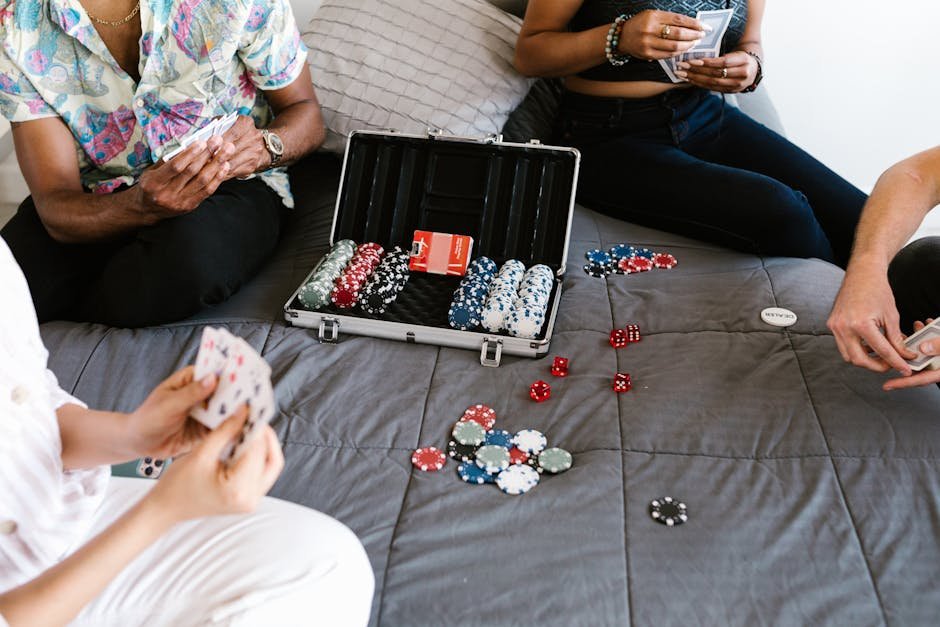
Home poker games for low or no stakes, played for chips with no cash exchange, retain the cognitive workout while removing the financial risk that can spiral into problem gambling. Many U.S. cities have weekly home games organized through Meetup or community boards. The cognitive payoff includes practice in tolerating uncertainty without panic, a skill that translates into anxiety management. People who already have a tendency toward gambling problems should be cautious; for them, even no-cash games can reinforce a vulnerability, and other card games are usually a better choice.
Cribbage, canasta, euchre, and regional traditions
Beyond the headline games, American card culture is rich with regional traditions. Cribbage, with its peg board and centuries-old scoring conventions, remains popular in New England and the upper Midwest, often played in coffee shops and senior centers. Canasta, a partner game using two decks, has experienced a quiet revival among Gen X and millennial players who learned from grandparents. Euchre dominates Indiana and Michigan; pinochle has German-American strongholds; spades has long been a fixture of Black American social life and college dormitories.
Each of these games has its own cognitive profile, but they share the core ingredients that research suggests matter for mental wellbeing: pattern recognition, social interaction, structured rules that make conversation easier for people who find unstructured socializing difficult, and a mild competitive element that engages reward systems. People who develop late-onset social anxiety after retirement or bereavement often find a regular card game an easier social re-entry than a discussion group. The structured frame removes the burden of generating conversation; the cards do that work.
Healthy gaming versus problem gambling
The line between recreational card playing and problem gambling matters. The Diagnostic and Statistical Manual classifies gambling disorder as a behavioral addiction, with criteria including preoccupation, increasing bet size to maintain excitement, chasing losses, and disrupted relationships or finances. Problem gambling overlaps with substance use disorders neurobiologically and frequently co-occurs with mood disorders.
Card games played for stakes can be a benign social ritual, a serious financial risk, or a clinical disorder depending on context, frequency, and the individual. Warning signs include hiding play from family, borrowing money to play, neglecting obligations, and persistent emotional dysregulation around outcomes. The National Council on Problem Gambling operates a 24-hour helpline at 1-800-GAMBLER. Treatment for gambling disorder includes cognitive-behavioral therapy, peer support through Gamblers Anonymous, and in some cases crisis intervention for gambling-related suicidality, which is unfortunately a known risk in severe cases.
For the vast majority of recreational card players, however, none of this is the relevant frame. Penny-ante home games, sanctioned no-cash bridge clubs, and family gatherings around a euchre table are wellbeing practices, not gambling.
Multigenerational play and family connection
Card games are one of the few activities that genuinely span generations. A grandparent and a seven-year-old can play go fish together; the same grandparent and a teenager can play spades. The conversation that happens around a card game between a grandparent with early dementia and a grandchild often outlasts the cognitive decline; even when names slip, the rules and rhythms of a familiar game remain accessible. Caregiving experts working with families dealing with cognitive emergencies, including stimulant hyperthermia and other acute presentations in older adults, often suggest a regular card game as a structured, low-pressure visit format that provides connection without the emotional weight of repeated explanations.
The pandemic-era return to family games at home, which many sociologists noted in 2020 and 2021, has partially persisted. Board game cafes, monthly tabletop nights at libraries, and family game nights have given parents and children a non-screen activity that builds cognitive and social skills. For divorced or separated families, a card game during a custody handoff can ease awkwardness; for blended families, learning a new game together creates shared territory.
Online card platforms and the post-pandemic shift
The pandemic accelerated online play. Bridge Base Online, with millions of users, became the daily fix for ACBL players locked out of clubs. PlayOK, Trickster, and similar platforms host euchre, spades, hearts, and pinochle. Apps like Pokerrrr 2 enable private home-game-style poker without cash. For homebound or rural seniors, online play preserves the cognitive workout when physical clubs are inaccessible.
The social benefit is partial. Online play maintains pattern-recognition and decision-making demands but lacks the in-person connection that the research suggests is part of the protective effect. Many older adults who shifted online during 2020 returned to in-person clubs as soon as they could, reporting that the chat function did not replace the coffee, the laughter, or the casual chatter at the table. Hybrid models, where a club meets in person weekly and online sessions fill in between, seem to capture the best of both. People dealing with cognitive changes that make complex play difficult sometimes work with a geriatric psychiatrist to find appropriate-level games, since playing a game above one’s current capacity can become demoralizing.
Finding local games: senior centers, libraries, and clubs
Most American communities have more local card play than residents realize. Senior centers, often funded through Older Americans Act allocations, host weekly bridge, canasta, and pinochle groups. Public libraries increasingly run game nights, both for adults and intergenerational. Faith communities run games as fellowship activities. The ACBL website maintains a club locator searchable by zip code; the U.S. Bridge Federation lists tournaments. Meetup groups exist for poker, magic-the-gathering crossover players, and casual game nights.
For someone re-entering social life after a loss, illness, or move, a card game offers a remarkably low barrier to entry. New players are typically welcomed because card games need a fourth, a sixth, or an eighth, and regulars notice the absence of a missing face. Showing up consistently for six weeks tends to be the threshold beyond which a new player becomes “one of us.” That sense of belonging is itself a piece of the mental health benefit that the research has begun to quantify.
Frequently asked questions
Will playing bridge prevent Alzheimer’s?
No single activity prevents Alzheimer’s. Regular bridge play is associated with slower cognitive decline in observational studies, and is included in general healthy-aging guidance, but it is not a guarantee. It is one component of a broader cognitive-reserve approach that includes physical activity, social engagement, sleep, and management of vascular risk factors.
Is it too late to learn at sixty or seventy?
No. Senior centers and bridge clubs regularly teach new players in their sixties, seventies, and beyond. Beginner classes assume zero prior knowledge. Learning a new complex skill in older age is itself associated with cognitive benefit.
Are video games as good as card games?
Video games offer some cognitive benefit, particularly action and strategy games, but the social component of in-person card play does not transfer fully to most video gaming. Cooperative tabletop board games and in-person card games provide a richer social-cognitive package.
What if I get frustrated with losing?
Losing tolerance is something the games themselves teach over time. If competitive frustration is causing distress that lingers for hours or days, that may be a signal worth discussing with a therapist; it can sometimes reflect underlying perfectionism or rumination patterns.
Can people with hand tremor or vision loss still play?
Yes. Card holders, large-print cards, tactile-marked decks for blind players, and online interfaces all extend access. ACBL clubs accommodate disabilities and many sanctioned tournaments offer accessibility services.
The bottom line
Card games have been part of American social life for centuries, and the recent research suggests our grandparents were onto something. The combination of cognitive challenge, social connection, structured ritual, and low cost makes regular card play one of the more accessible mental wellness practices available, particularly for older adults. The benefits accumulate over years rather than weeks, but the sense of belonging and engagement often arrives within the first few sessions. Showing up matters more than winning. The card games cognitive health connection rewards consistency and rewards returning to the table even on the days when not much else is going right.
If you are in crisis or thinking about harming yourself, call or text 988 to reach the 988 Suicide and Crisis Lifeline, available around the clock in the United States.
For information on cognitive aging and gambling concerns, see the National Institute on Aging and the National Institutes of Health.
This article is for general educational purposes and is not medical advice. Speak with a qualified clinician about your specific health situation.